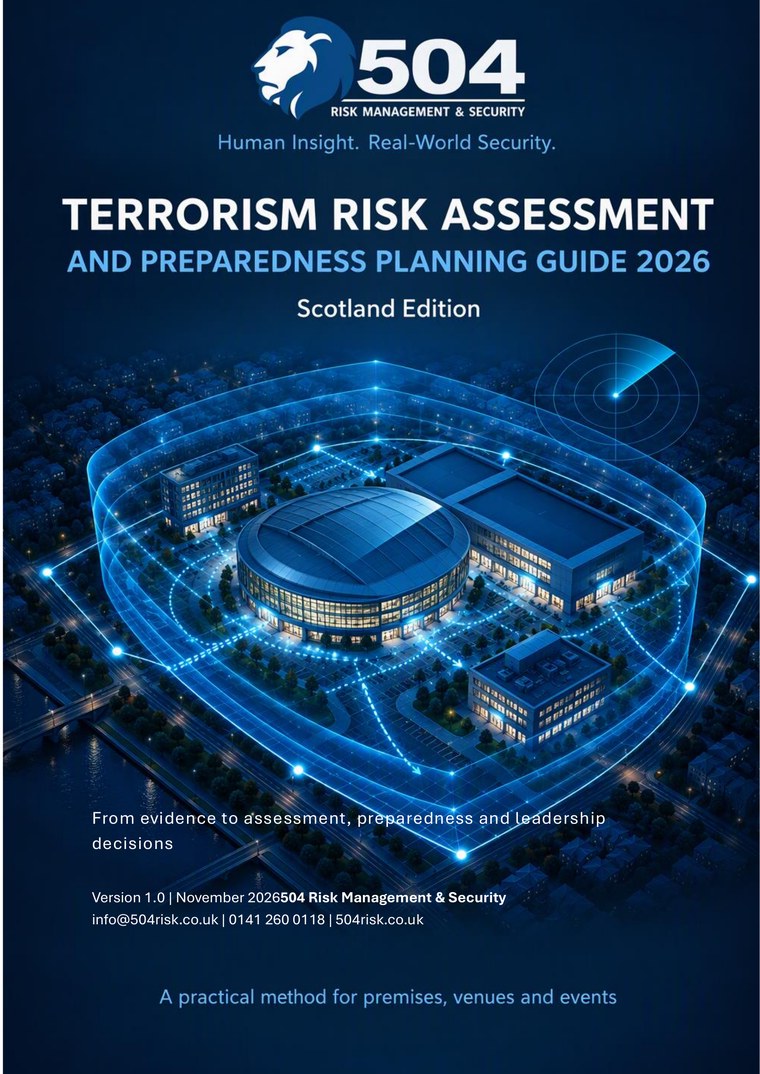
Terrorism Risk Assessment and Preparedness Planning Guide 2026
Scotland Edition. A clear method to assess terrorism risk, turn it into a plan, and present the decisions to your leadership.
Built for the person who has to do it
An enhanced tier assessment has to be documented, proportionate and defensible. That means showing your reasoning, not just your conclusion, and being able to explain why you did not adopt a measure as clearly as why you did.
This guide takes you from evidence to a completed assessment, to the preparedness plan that follows from it, to the paper you put in front of your board. You do not need to be a security specialist to follow it, and it is clear about the point at which specialist help is needed.
- EditionScotland
- Length68 pages
- MethodFive stages, five-by-five matrix
- TemplateEditable twelve-section assessment
- Worked exampleFictional hotel, evidence to board paper
Five stages
The guide follows the ProtectUK Risk Management Process, the national approach to counter-terrorism risk, which is built on ISO 31000.
- Identify the risks. Threats, vulnerabilities and the assets that matter, producing a risk list specific to your premises.
- Assess the risks. Likelihood and impact scales, a five-by-five matrix, priority bands and acceptance criteria, so scoring is consistent and explainable.
- Treat the risks. Choosing proportionate controls, using the ProtectUK Controls List and Menu of Tactical Options, and recording the risk that remains.
- Record your actions. What you decided, why, who owns it and by when.
- Review. When to revisit, what triggers an early review, and how to keep the assessment current.
Inside the guide
- The legal context in Scotland. Including what reasonable practicability means in practice.
- Roles and competence. Who should do the assessment, and when the work exceeds what you should be doing yourself.
- A fully worked example. A fictional hotel taken from first evidence through to the board paper, so you can see what good looks like before you start your own.
- Preparedness planning. How the assessment becomes an operational plan, including events.
- Making the case to leadership. How to present recommendations, and the moral, legal and financial arguments that carry weight.
What you can use straight away
Part 6 is the working section. Everything in it is editable and licensed for internal use.
- Twelve-section Terrorism Risk Assessment template, with a self-assessment edition
- Scoring card
- Evidence and consultation record
- Decision log
- Review schedule
- Recommendation template
- Board report template
- Pre-assessment checklist
- Tailored specifically to Scotland
- Aligned to the Terrorism (Protection of Premises) Act 2025 and current national guidance
- Not legal advice, a compliance certificate, or a substitute for specialist advice where the work exceeds your competence
When you should stop and call someone
The guide is explicit about its own limits, and so are we. A method helps you produce a defensible assessment for a premises you know well. It does not replace judgement on a complex site, a shared building with contested responsibilities, or an event where the risk picture changes with the programme.
If you work through it and conclude the job is bigger than you thought, that is the guide doing its job. The Readiness Review exists for exactly that point.
Request a licence.
Or if you would rather have the assessment done with you, start with a conversation instead.
Request a licence Book a Readiness Review